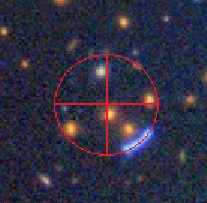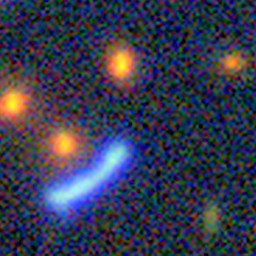
https://www.legacysurvey.org//viewer/?ra=1.2145&dec=-1.0548&layer=hsc-dr2&zoom=16
Odd one that
can’t decide if it’s lensing or not…
I would think so. Down in a bunch of catalogues as one.
So bright
cheers 
I agree that it is very odd to see such a prominent blue arc associated with no significant cluster of galaxies or even one particularly massive galaxy. But it’s definitely there!
I also think it’s slightly odd that the three galaxies upper left all appear to have the same morphology and alignment. This is definitely an odd one!
It is a gravitational lensed image with a kown gravitational lens candidate.
Ine
Yes, but it’s still pretty unusual! What is lensing it?
there are any of two galaxies that could be responsible for the lensing…even though it has all the attributes, my gut says it isn’t a g. lens which is why I posted it under 'beautiful/unusual objects…
There’s a fairly obvious cluster there. Cluster lensing can be pretty crazy.
Maybe, but cluster lensing should produce an arc that is roughly centred on the centre of mass of the cluster, and that doesn’t appear to be the case here. Also, with such a dispersed cluster as this but such a strong lensing effect, I would expect the cluster to be lensing other objects too. It’s definitely out of the ordinary. I wonder if this might be lensing caused by a “rogue” wandering black hole, ie one not at the centre of a galaxy???
I’d like to see that one looked at by Hubble! 
It’s possible it is lensing other objects, but this is the only one bright enough for HSC to resolve. As for centre of mass, I wouldnt feel comfortable estimating where that is lol, though i’d note that cluster lensing can produce very odd shapes/configurations/positions. We’re seeing this in glorious detail with JWST.
Odds of a random wandering black hole, firstly being capable of producing such a lens (would either have to be extremely close or extremely massive), but also happening to align with a galaxy cluster so perfectly… I think occam’s razor probably comes in to play here.
Agreed. alignment with that cluster and the properties it would have to have do seem to Occam’s razorify the set of solutions.
Yes, and someone else always wins the lottery, too.
I’m looking at the morphology and trying to account for it through physics, not probability. If you can explain how such an extremely bright gravitationally lensed object can appear, in the absence of any others bright enough to be resolved by HSC, adjacent to what by any objective assessment has to be a not particularly dense galaxy cluster, then I’d be very interested in hearing the explanation.
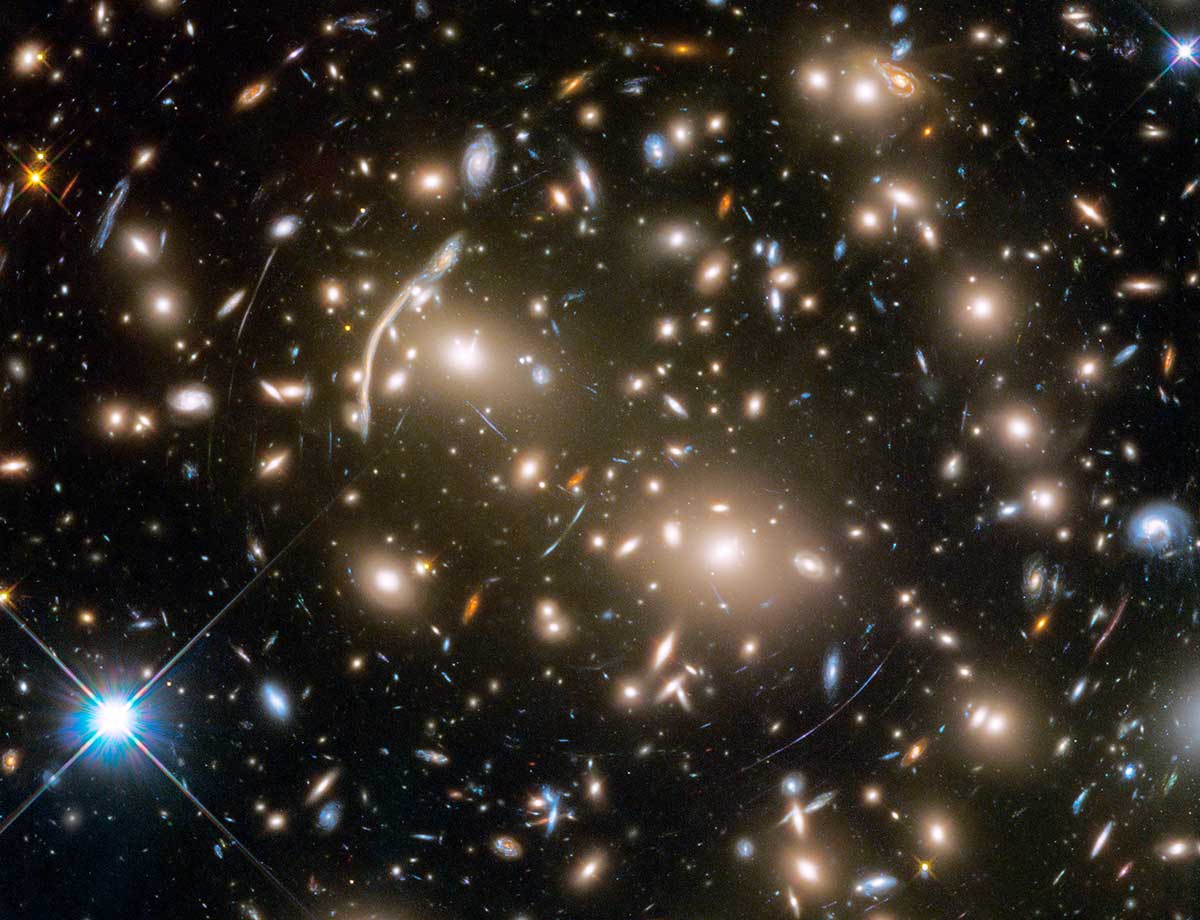
Much like this example, I’d imagine:
You can see how lower resolution would mean only one lensed image is likely to be resolved (the bright one top left of centre).
If this was caused by a wandering BH, it would have to either be supermassive and mysteriously have no visible material in orbit, or stellar mass and close enough to climb in to bed with us (pretty sure stellar mass black holes have only been observed to cause microlensing, but I may stand corrected).
The spectroscopic redshifts from the arc and one of the cluster galaxies work out for a lensed imaged (the lensed image having a much higher redshift)
I agree with that the cluster looks very light to produce such an image, and personally I had doubts because of the thickness of the arc, not being a regular slicer of an arc.
Part of the issue probably is that the lensed galaxy is starforming / starburst so it looks brighter than others.
Perhaps also something weird is going on with the infamous ‘Dark Matter’ in this case?
PS at least it looks happy : )
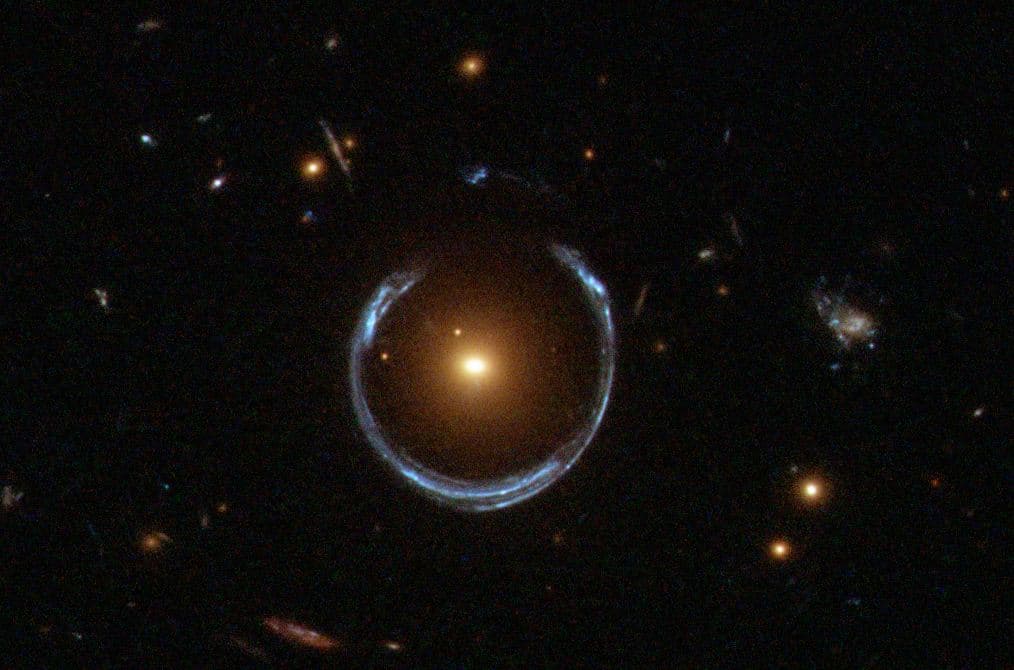
If a single galaxy can produce a lens like this:
I don’t think its inconceivable that even a small-ish cluster could produce the lensing effect in the OP’s post.
I think the thickness of the arc is generally a result of viewing geometry? It certainly looks very bright, and starburst could definitely be a reason.
Haha, I try to not think about Dark Matter as much as possible  It kinda breaks my brain
Ha I have my own little (as of yet unquantified) little stickhorse crank theory about that.
But I don’t want to derail this thread and besides, I’ve already heard enough about that it can’t work and why not from too many people so I guess that’s that  no more bashing needed
Assuming a simple center of mass instead of something complicated that has to be modelled, I think this is the smallest position of center of mass possible.
I think larger circles would probably fit the arc but then the center of mass for the lensing would get so far away it is pretty much illogical. (likely though the circle has a too small diameter)
The weird thing is I can’t see any other kind of lensing effect around this area. Not even a counter-image hich I guess should be visible from such a bright lensed galaxy…