Nice overview of gravitational lensing;
2 Likes
Again, i’m nowhere near comfortable assuming a centre of mass tbh haha.
I think viewing geometry is key though. A counter image may be expected if the lensed galaxy is situated close to directly behind the foreground galaxy from our perspective, but if its to one side, it may only be slightly curved by the lens, and therefore stay brighter, allowing it to be more easily resolved - in which case a counter image would be unlikely.
5 Likes
From a physicist’s point of view, I find that argument a bit “hand waving”. It’s like saying “I know what the laws of physics say should be happening, but this is different”, without actually explaining why it is or should be different. A gravitational lens has to have a centre of mass somewhere, and that has to be explained by the distribution of visible mass, otherwise we are in the realm of “dark matter”, which to me is just a way of describing what can’t be explained by current interpretation. It isn’t necessarily a real entity.
1 Like
Which argument? I don’t think anyone’s suggested dark matter as a serious explanation.
1 Like
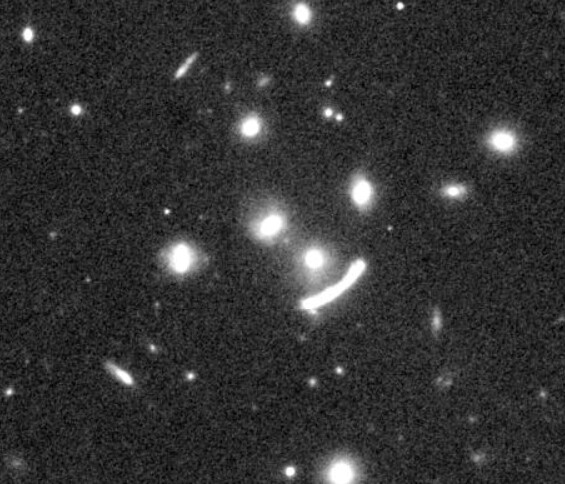
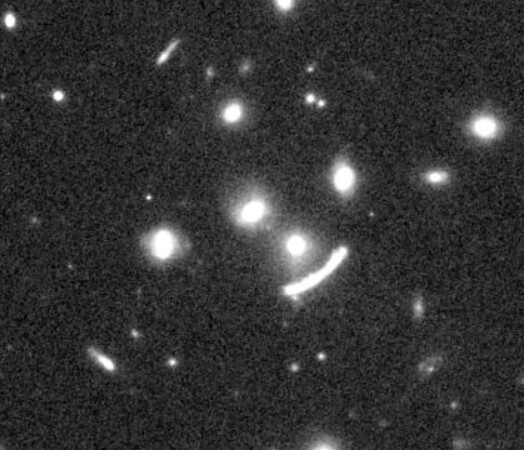
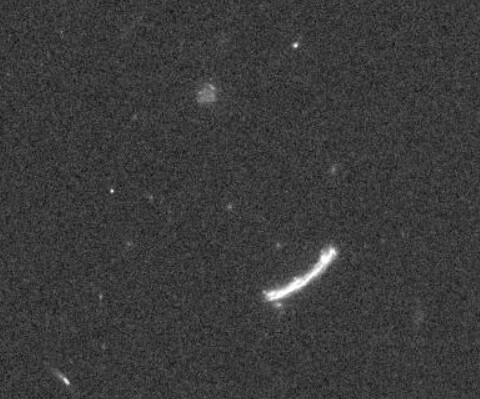
Looks like there’s HST/WFC3 images of the area.
F125W (Wide J-band filter, so near-infrared):
F160W (Wide H-band filter, so slightly later near-infrared):
F390W (Washington C filter [3900 Angstrom]:
F814W (Wide I band filter [8140 Angstrom]):
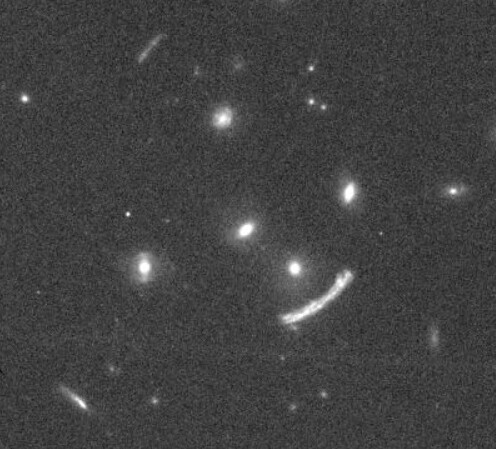
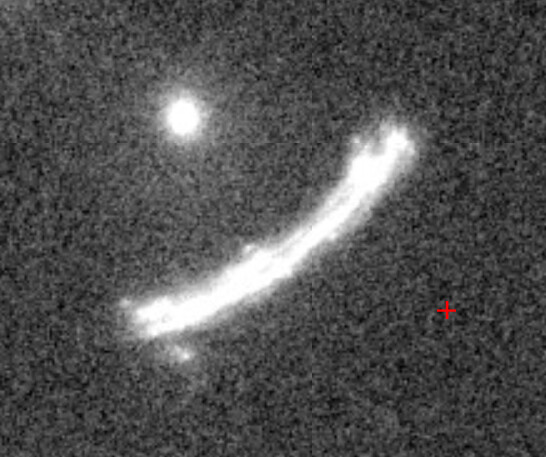
The combined UVIS mosaic (so all the bands listed aside from the near-infrared one), arguably gives the best detailed for the putative lensed image:
3 Likes
I have long argued that the lenses we catalog in a region are a very tiny fraction of all lenses in it.
Just as most points in space are (or seem) empty, most lenses will be dark
Every field in physics has this habit though and I would not say it’s necessarily bad physics. While I am not saying it is right here, if you propose something that fixes your problems and works in doing so, then it is a good enough gap-filler. Phillip Anderson proposed the (Anderson-)Higgs mechanism in the late 60’s and it fixed a bunch of problems for condensed matter physicists but it had a shaky formulation initially. However, it worked so it was used and then, eventually, someone came and patched up the problems. Throwing stuff at the wall and seeing what sticks and then trying to reason it, seems to be how physics discoveries are made.
1 Like
Niko, that isn’t what is happening here though! Gravitational lensing models simulate where the mass is distributed that would generate the image we see. It is indeed rare for a gravitational lens to involve a single point mass. So one instead looks at a number of identifiable masses (i.e. galaxies) and estimates where the centre of mass would be for that group, as with AFJ’s “gunsight” graphic.
Even with Tom’s HST images it seems there is very little lensing of anything else, except that the streak to the top left may be another lensed galaxy, which confirms AFJ’s targeting pretty well!
Anyhow, after seeing the HST close-up that Tom posted, I’m convinced - it’s certainly a remarkable and unusually bright lensed galaxy! 
1 Like
Yes but Tom was having a guess, not running a lensing model.
I think we are all guessing! 
2 Likes
Yeah, simple fact is that we dont have enough data to say anything with any certainty here lol. We dont know where the centre of mass is, we probably cant see all the galaxies in the cluster, we probably cant see all the lensing.
1 Like
Any spectra available for that lensed galaxy? It would be nice to know the redshift.
1 Like
Seems to be one from https://iopscience.iop.org/article/10.3847/1538-3881/aaa2ff putting it at z = 1.681100
3 Likes