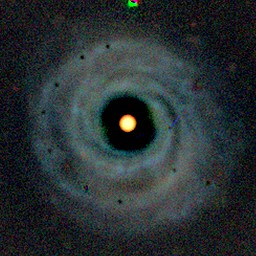
https://www.legacysurvey.org//viewer/?ra=33.1765&dec=13.9691&layer=ls-dr9-resid&zoom=14
are (most) of the smaller black dots, stars within the galaxy?
https://www.legacysurvey.org//viewer/?ra=33.1765&dec=13.9691&layer=ls-dr9-resid&zoom=14
are (most) of the smaller black dots, stars within the galaxy?
There probably are some starforming clumps on those areas but they are not very distinctive. Starforming areas in our galaxy includes hundreds to tens of thousands of stars. Your example galaxy is about 600 million light-years away (z=0.041 in SIMBAD), so individual stars at that distance couldn’t be detected (imagine thousands of tiny dots inside the black dots, and the resolution needed to detect those).
You can’t really see those black dots on other than model and residual images, not the original image. My guess on this is that as the elliptical galaxy model (see the “Legacy Surveys DR9 models” option on the viewer) is applied on the spiral galaxy, the software interprets the galaxy’s starforming areas as stars in our solar system. Then the model is subtracted from the original image to get the residual image (as in your example) and as there were no stars to begin with, they appear as black dots.
The even spread of the black dots looks pretty cool though.
what? I meant the question as if seeing a star forming galaxy vs an elliptical for example. we can see the ‘stars’ that’s how to know the difference. I do not mean a singular star. I have seen the ‘negative’ image of a black dot/circle, repetitively within starburst, star forming, spiral galaxies, etc. I am just wondering the significance if any? could they be something more specific within a galaxy?
The black dots are a result of the model not knowing how to handle a bright complex galaxy, so it’s guessing that there’s a circular pattern of stars where in reality none exist. The residual layer (which is the one you’re looking at) is basically the real image minus the model. Hence the black dots.
They can be safely ignored. In fact, most of the solutions the model produces can be ignored tbh lol.
ok so the colors or any shapes can be ignored also? do the colors not mean different things (x-ray, etc?)
In image data nothing should be ignored.  But in residuals there will be lots of stuff that isn’t really there, because residuals are just subtractions of digitally created models (not real image data per se).
Given that DECam only covers visible bands, you will never see any x-ray light.
like a negative? like in photography?
so the colors mean nothing? there is no consistency when viewing Legacy in general or?
Legacy has 4 bands. What color something appears depends on the brightness at different bands. So the colors dont mean nothing - in fact, i’m not entirely sure what you’re suggesting there.
Legacy only covers g, r, i & z, which are all visible light bands. Xray light is much shorter wavelength. You dont tend to get sky surveys in the visible AND another region of the electromagnetic spectrum.
i dont know how else to ask what im asking
Look at the models


yes the models, i did, and so the the black spots are a result of the brightest spots turned ‘negative’ by the models, no?
That’s correct, the model is subtracted from the actual image to get the residual image.