Found this object it doesnt appear in Simbad Or Ned Could it be a new galaxy?
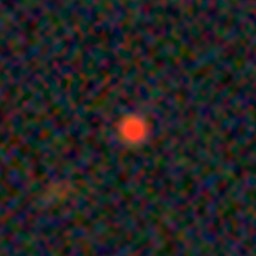
2 Likes
I think it looks more like a star. while distant galaxies do often appear red. This looks closer to other nearby objects that I am sure are stars. but I have zero doubt if you keep looking you will see millions upon million of distant galaxies that appear red at extreme distances. Sometimes they form clusters and the deeply red galactic clusters I like to call a berry patch. They really are a bunch of small spots on the night sky that is literally trillions of stars.
Could this be a new star or a star thats already been found
1 Like
it is possible. I find things all the time that do not have catalog numbers and have never been mentioned in publication or research. there are countless stars in the night sky viewable that have no catalog number currently. and even among the ones that do many have no spectral classification identified. a catalog number a dozen digits long is the best we can do currently. there are so many stars it will take all of us to do it! but there are plently of new even strange stars out there. There’s billions of galaxies visible on here I have no doubt. just keep looking stuff up in Simbad and use the object types button in the upper right menu bar and type in the short hand code for the object type. There’s a lot to see, but that can help you grasp to some extent what you are looking at. Sometimes it’s a Quasar, others it is a Chemically Peculiar Star. other times white dwarfs. after awhile you’ll be able to recognize certain objects by type or color. but it is very diverse.
Also there are so many stars and even approaching 3 years on Legacy Survey there are entire constellations I still havent even looked it yet. You may very well be one of the only people to ever have even seen some of these stars albeit from a device ie telescope images. but I’ve seen the inside of the telescope on top of Van Allen Hall and they were looking at a screen as well. It is a cool time to be alive.
Thats strange a Z of 0.519 ± 0.321 that means its far but if it is that far then how could have We detected it if it was a star
1 Like
That is a great question and I am curious to know the answer to that. I have learned a lot from Legacy Survey. I am terrible at judging distances and even Quasars can easily be mistaken for a star visually. Ton 618 is a good example. When someone says they found the distance to it, I’m not even sure where they are looking at to find that information. I am a visual person as an Artist so I lean on that for initial identification often. Color plays a big part here. Red Shift and Red Stars are tough to tell apart sometimes. I recently learned only 1 in 160 of the stars nearest to us are blue and white stars, yet they make up most of what we can see in the night sky with the unaided eye. I think Legacy Survey is the most forward thing I have ever encountered. NERSC Supercomputers and everything. I wish there were more People on here because I have posted things I didn’t get an answer to yet. There’s a lot to look at. and Who can blame anyone for just getting lost in space speechless. It is a rare time to be alive. We can see the stars that are mapped and undocumented together and the distances are unfathomable. the closest known star Proxima Centauri is 4.25 light years away. The fastest a manmade object has ever gone was 165,000 mph; The New Horizons probe. at that speed continously it would take approximately 17,000 years to arrive and it’s moving at breakneck speed. Starring and studying stars is about all anyone can hope to do with current technology. despite our place in the Future, I think steam engines are the future of space flight. if not outright starlight. Turn a lighthouse lens around and let the sunshine in. The Sunshine Engine; catch a comet by its tail. the fresnel lens condenses light onto the water/ice or some other device that transfers and distributes heat, possibly graphine and turns the water to steam. all a nuclear reactor really does is make steam that turns a turbine. can it turn a watch? just a lil bit? the cold of space could help reclaim water. What is nice about steam is that I can potentially use a small release of it to change heading which would solve a lot of challenges of space exploration. In deep space collecting light might be the only way to get a closer look. I’m surprised we havent built an observatory on the Dark Side of the Moon.
I hope you keep mapping the Heavens!
Hi, and welcome 
A photometric redshift (guessing the distance from the color) of z=0.519 ± 0.321 – that’s a very large ± range. This could certainly be a red star inside the Milky Way, or a distant galaxy.
For example, here is a nearby object of a similar color where DESI has taken a spectrum and determined that it is a galaxy at redshift z=0.665.
But then here is a star of a similar color that the Gaia spacecraft has observed to be moving - therefore definitely a nearby star -
So basically, it can be hard to tell without follow-up observations!
In the sky viewer, the main things I would check are:
under the “Imaging catalogs” menu, turn on the “Gaia EDR3” labels - those are measurements from the excellent Gaia mission. If they measure a significant proper motion, it’s basically guaranteed to be a star. They only measure relative bright objects, though.
Also the DESI DR1 spectroscopy, and SDSS spectroscopy - again, usually only for brighter objects - if there is spectroscopic follow-up, they can usually be pinned down.
cheers,
dustin
1 Like
Hi there thanks for giving the tips
I checked the DR3 labels for it seems like gaia hasnt found it maybe a galaxy, either way ill be continuing observing it with my other galaxy im currently observing
1 Like