The common eigen mode postulate is basically where Schwarzschild radius meets the Planck photon wavelength relationship.
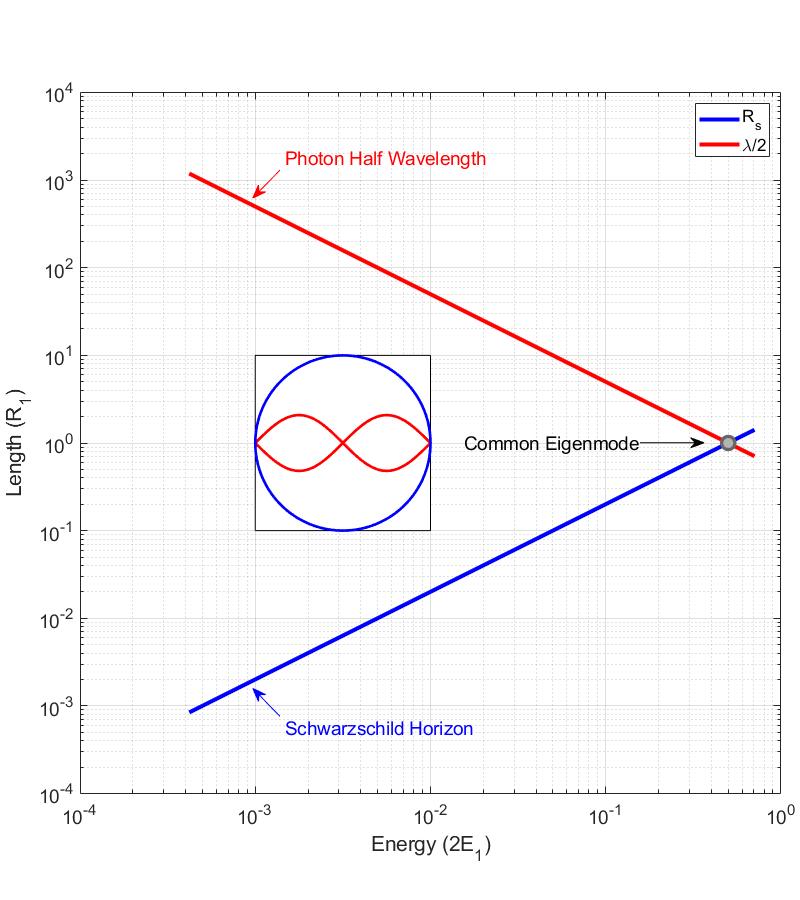
So the common eigenmode postulate is just that this Planck mode must be an eigenmode of the cosmos.
The common eigen mode postulate is basically where Schwarzschild radius meets the Planck photon wavelength relationship.
So the common eigenmode postulate is just that this Planck mode must be an eigenmode of the cosmos.
We needed deep fields just to detect z=14 galaxies (JADES was ~770 hours). I have no idea how you expect z=28.5 galaxies to be detected.
Ohhhh you’re one of those people 
I thought JADES was also 11.5 hours. My bad 
 Okay then maybe you are right, we need a bigger telescope!
Okay so I did a little searching and found: https://arxiv.org/pdf/2306.02465
Here is the abstract:
“We present an overview of the James Webb Space Telescope (JWST) Advanced Deep Extragalactic
Survey (JADES), an ambitious program of infrared imaging and spectroscopy in the GOODS-S and
GOODS-N deep fields, designed to study galaxy evolution from high redshift to cosmic noon. JADES
uses about 770 hours of Cycle 1 guaranteed time largely from the Near-Infrared Camera (NIRCam) and
Near-Infrared Spectrograph (NIRSpec) instrument teams. In GOODS-S, in and around the Hubble
Ultra Deep Field and Chandra Deep Field South, JADES produces a deep imaging region of ∼45
arcmin2 with an average of 130 hrs of exposure time spread over 9 NIRCam filters. This is extended
at medium depth in GOODS-S and GOODS-N with NIRCam imaging of ∼175 arcmin2 with an
average exposure time of 20 hrs spread over 8–10 filters. In both fields, we conduct extensive NIRSpec
multi-object spectroscopy, including 2 deep pointings of 55 hrs exposure time, 14 medium pointings
of ∼12 hrs, and 15 shallower pointings of ∼4 hrs, targeting over 5000 HST and JWST-detected faint
sources with 5 low, medium, and high-resolution dispersers covering 0.6–5.3 μm. Finally, JADES
extends redward via coordinated parallels with the JWST Mid-Infrared Instrument (MIRI), featuring
∼9 arcmin2 with 43 hours of exposure at 7.7 μm and twice that area with 2–6.5 hours of exposure at
12.8 μm. For nearly 30 years, the GOODS-S and GOODS-N fields have been developed as the premier
deep fields on the sky; JADES is now providing a compelling start on the JWST legacy in these fields.”
So 770 hours was total cycle 1, which was mostly NIRCam spread over 175 arcmin^2.
For z = 28.5 a normal galaxy that emits starting at the Lyman break of 91.2 to 900nm will have a shift of 2.7-26.6 μm so a little bit of NIRCam up to just barely in the range of MIRI which was only 43 hours for the total 9 arcmin^2. But we need to do some corrections for luminosity output.
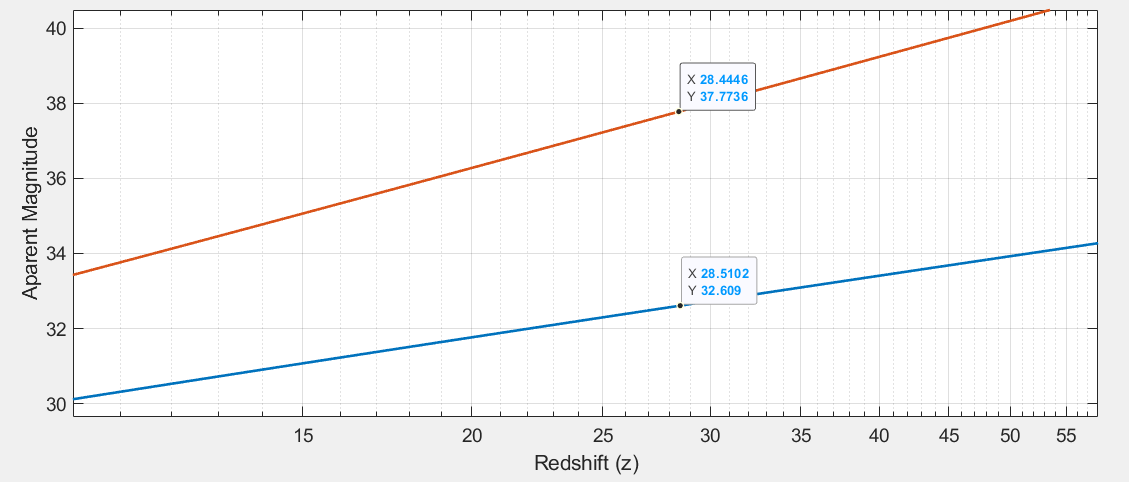
Let’s suppose we could potentially get something that is M = -20. This would mean we expect it to have an apparent magnitude of m = 32.6, which is bad, I know.
Actually it should be closer to 37.8 apperent magnitude if my theory is correct 


Yeah…, I am 
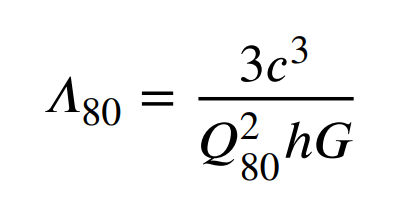
Lambda = 1.9x10^-52 m^-2
where (Q_80)^2 = 961765800262981034672241053669 ⋱
421132598586198892934205401727 ⋱
869202053672117248093116977969 ⋱
2060254138361595956607664292096
is the exact number of spin states to compute the universe 
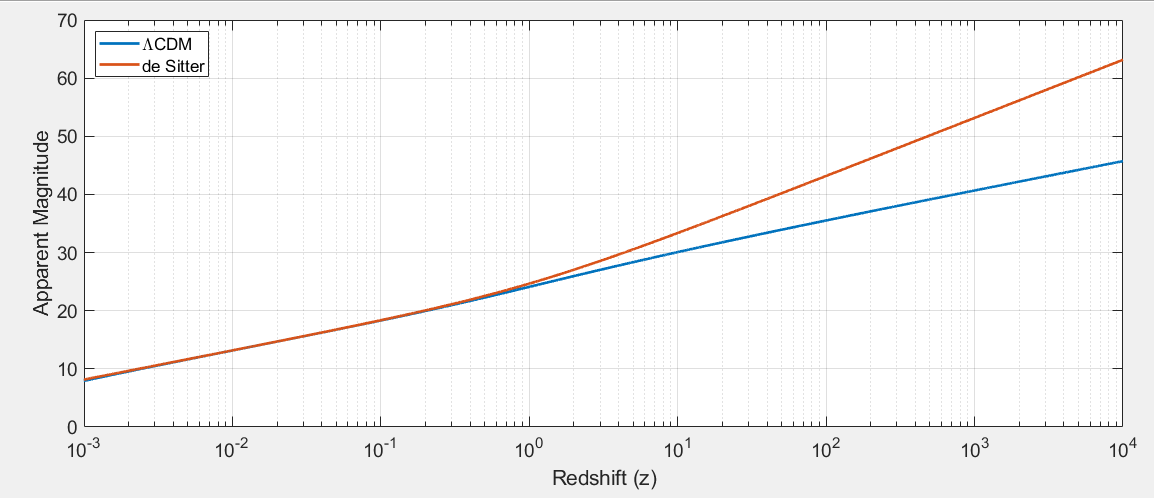
This graph is based on two different cosmologies with absolute magnitude M = -20 object. Even the de Sitter cosmology would have an apparent dark ages!
No I didn’t see that… wow thank you so much Dustin! 
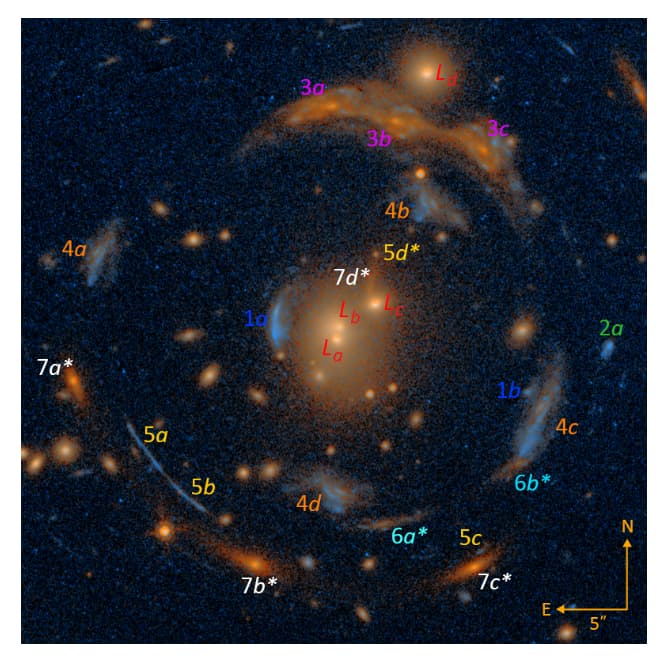
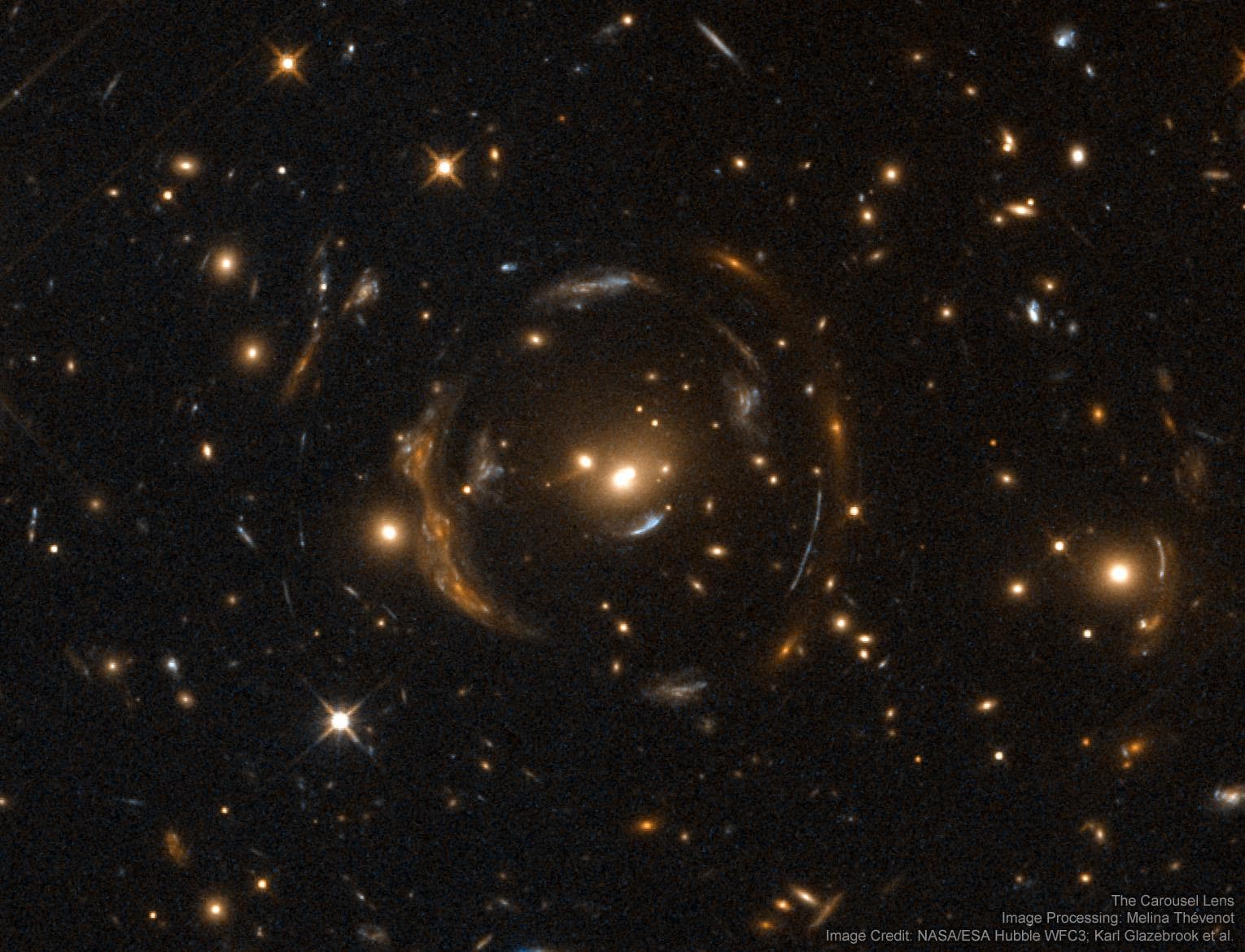
Someone also self processed the images to get this view and I guess this lens is called the Carousel Lens:
https://www.reddit.com/r/spaceporn/comments/1fkg4jn/the_carousel_lens_selfprocessed_image/#lightbox